

Drift Exploit: Navigating the $44 Million Tornado
July 24, 2026 08:30
Weekly Crypto Gainers: An On-Chain Analysis
July 24, 2026 08:38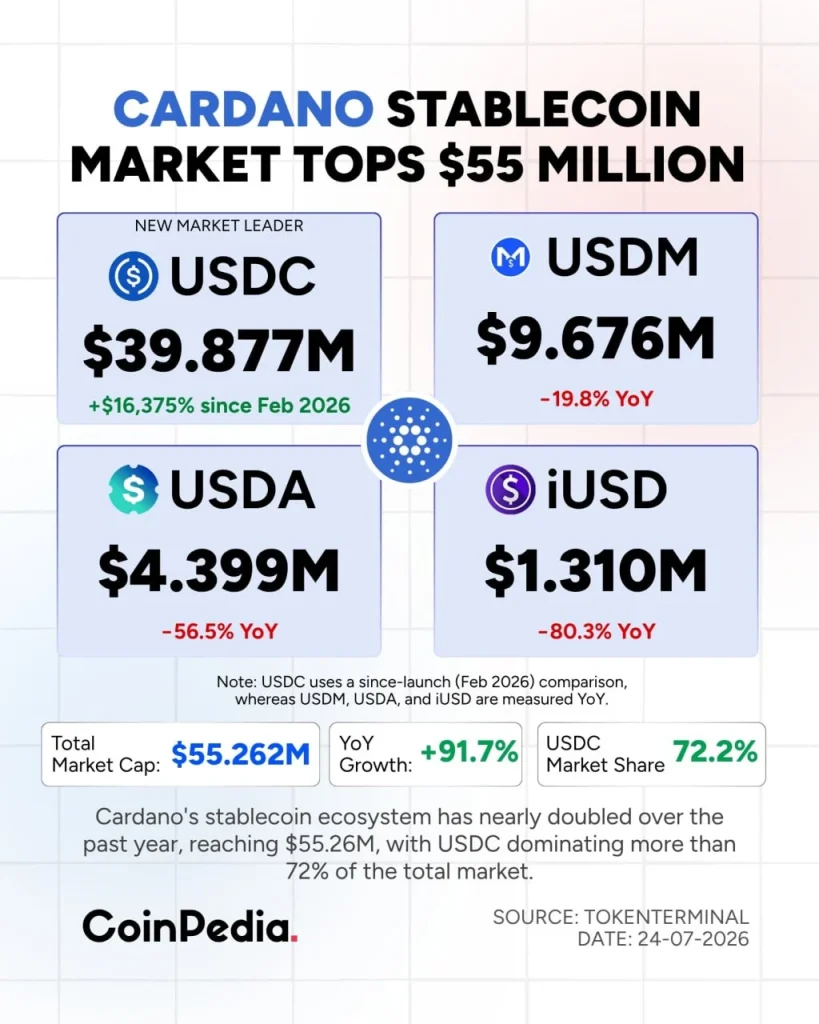
Cardano’s Stablecoin Surge: What It Means for You
What Actually Happened
So this just happened: Cardano’s stablecoin market cap has topped $55 million. That’s a 91.7% jump from last year. Impressive, right? The star player here is USDC, which alone holds $39.88 million, claiming about 72.2% of the stablecoin scene on Cardano. If you’re watching ADA’s moves, this is one to note.
This growth is happening amid a broader crypto environment where stablecoins are becoming the go-to choice for those who want to minimize risk. Think of them like the crypto equivalent of sticking your cash under the mattress. Safe, predictable, and kinda boring—but sometimes that’s exactly what you need.
Why You Should Care
Nobody’s going to say it plainly, so I will: this affects you. Stablecoins are becoming a bedrock in the crypto world, offering a steady alternative to the wild swings of other digital assets. For Cardano, this means a more robust ecosystem and potentially more retail and institutional interest.
If you’re holding ADA or considering it, this trend can impact its value and utility. As stablecoins take up a larger market share, they could drive more liquidity—basically, how easy it is to sell or buy ADA at a stable price. More liquidity generally means less volatility, which can be a good thing if you’re not into heart-stopping price drops.
The Part Nobody’s Talking About
Here’s the part that actually matters for regular people: Cardano isn’t just doing this for fun. There’s a strategic angle here. By strengthening its stablecoin offerings, Cardano is positioning itself as a more attractive platform for decentralized finance (DeFi) applications. It’s like setting up the most reliable Wi-Fi before launching a tech startup.
More stablecoins mean more DeFi projects, and that could translate into more use cases for ADA. The potential for yield farming, lending, and other financial services grows as the stablecoin market expands. As discussed in our Ripple’s RLUSD Evolution, falling volumes can be a concern, but a strong stablecoin presence might mitigate some of that risk.
Historical Context: Stablecoins and Cardano
Cardano’s stablecoin journey isn’t happening in a vacuum. Remember when stablecoins first started gaining traction a few years back? They were all about providing a safe harbor during turbulent market times. Cardano seems to be leaning heavily into this narrative, perhaps learning from the challenges faced by other platforms.
Other networks like Ethereum have already seen explosive growth in their DeFi sectors, propelled by stablecoins. Cardano is clearly taking notes. By capturing a larger slice of the stablecoin pie, it could set the stage for more complex financial products and services. For instance, Binance’s push for tokenized shares indicates a broader trend towards blending traditional finance with blockchain tech, something Cardano may aspire to emulate.
Cardano vs. The Competition
If you’re thinking about how this positions Cardano against competitors, you’re not alone. Ethereum has long dominated the DeFi and stablecoin space, but Cardano’s recent moves suggest it’s not content to play second fiddle. By aiming for a more significant stablecoin market cap, Cardano is setting itself up for a bigger role in the crypto finance world.
However, it’s not just about numbers. Cardano’s approach, with its focus on security and scalability, aims to attract projects that may have been wary of Ethereum’s congestion issues. It’s like choosing between a crowded gym and one that guarantees you won’t have to wait for a treadmill.
What’s Next for Cardano’s Stablecoins?
I’ve been watching this situation for a few weeks now, and my honest read is: it’s complicated. As Cardano continues to build its stablecoin ecosystem, the implications are vast. From increased DeFi adoption to potential regulatory challenges, a lot is riding on how this plays out.
For regular folks like you and me, the real question is how this impacts ADA’s value and utility. Will we see more projects choosing Cardano over Ethereum? Or will regulatory hurdles slow things down? These are the questions to keep an eye on as we move forward. For more insights on market shifts, check out our piece on JPMorgan’s Jamie Dimon and his views on economic uncertainty.
So, there you have it. Cardano’s stablecoin market is growing, and it’s not just a number on a screen. It’s a sign of where things might be headed. Whether this is an opportunity or a risk depends on how you play it, but one thing’s for sure: it’s a development worth watching. If you’re looking to dive deeper into the crypto scene, consider exploring the opportunities available on MEXC.
Author: Caroline Weeks