

Dogecoin’s Price Teeters Near $0.07: Is a Short Squeeze on the Horizon?
July 25, 2026 11:39
LayerZero’s Big Decision: What It Means for You
July 25, 2026 11:46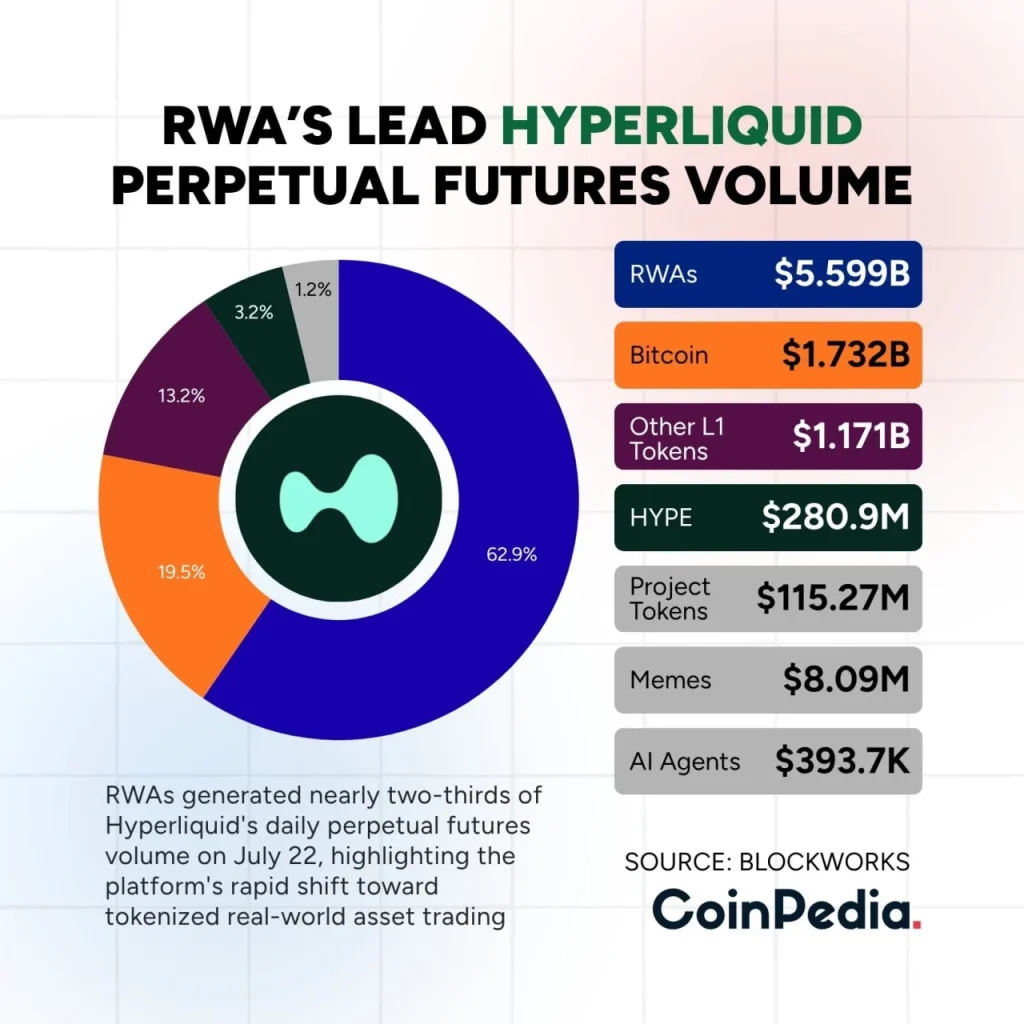
Real World Assets Overtake Bitcoin in Perpetual Futures Volume
The Rise of RWAs: A Shift in Market Focus
I’ve seen market transitions like this before — assets emerging from the shadows to dominate the spotlight. Most recently, real world assets (RWAs) took the lead in Hyperliquid’s perpetual futures trading volume, accounting for $5.599 billion, which equates to a substantial 62.9%. This is a noteworthy shift from Bitcoin, which held $1.732 billion or 19.5% of the volume on July 22.
These figures suggest a pivotal movement in the crypto-futures market. While Bitcoin traditionally enjoys a stronghold, RWAs are capturing investor interest. As someone who lived through the asset booms of the past, I recognize these as signs of a dynamic shift driven by evolving investor appetites.
A comparison can be drawn to the way alternative investments gained traction during past economic cycles. This shift demonstrates a cyclic structural transition as investors search for diversification amid global financial uncertainty.
Historical Context and Macro Implications
By comparing today’s numbers with those from previous economic cycles, we can identify a pattern. The emergence of RWAs in the crypto space mirrors the rise of real estate investment trusts (REITs) during past market volatilities. However, the scale and speed at which digital assets like RWAs have captured the market are beyond what we witnessed with REITs.
This move is partly driven by massive technological strides and a growing acceptance of tokenized assets. But it also aligns with larger macroeconomic trends. As inflation concerns and fluctuating interest rates linger, RWAs offer a seemingly stable alternative for cautious investors.
This change is quite similar to the 2013 rate cycle. Both point to discerning investment choices under macroeconomic pressure, emphasizing structural adjustments over cyclical movements.
Bitcoin’s Role: A Comparative Analysis
Hyperliquid’s numbers tell us that Bitcoin, while still significant, is taking a back seat in perpetual futures volume. Back in 2018, we saw Bitcoin trading at about $3,800, also facing competition from emerging assets. The scenario then closely resembles our present situation.
Bitcoin continues to be a staple in the crypto market, yet its dominance isn’t as certain as it once was. As discussed in our quantitative analysis, Bitcoin still holds ground due to its robust infrastructure and investor trust. However, the current shift underscores a greater market evolution.
Whether this represents a structural shift or cyclical correction remains to be seen. Nevertheless, Bitcoin’s role as a barometer for crypto market health cannot be dismissed, even amidst changing dynamics.
Investor Sentiment and the Shift to RWAs
The move towards RWAs isn’t just about numbers; it’s about changing investor sentiment. There’s a growing appeal in assets tied to the tangible world — possibly reflecting broader economic concerns.
In our volatile financial environment, RWAs offer promising opportunities. Unlike traditional assets, they enable fractional ownership and liquidity, qualities particularly attractive in uncertain times. Referring to data from our analysis on DeXe’s surge, it’s evident that investor confidence plays a pivotal role in defining market shifts.
The short-term noise is real. So is the long-term signal. RWAs may provide a bridge between traditional and crypto assets, forging new pathways for wealth preservation and growth.
Structural or Cyclical? Distinguishing the Pattern
History has taught us to differentiate between structural shifts and cyclical trends. The substantial leap of RWAs in perpetual futures volume pushes us to question this categorization.
Structural shifts are typically marked by underlying paradigm changes — in this case, the digital world merging more with traditional asset standards. The current movement may signify the digitization wave carrying us into a new economic phase. Yet, aspects of it could be cyclical, driven by temporary market conditions and investor strategies.
Structural adaptations, such as those we observed in the Federal Reserve balance rise, frequently redefine market compositions and opportunities. Understanding these matters for long-term strategic decisions.
What This Means for Future Trends
Looking ahead, the implications for traders and institutional investors are multifaceted. The growing importance of RWAs suggests a more diversified portfolio approach, one that smartly integrates crypto-assets.
In a world where entrepreneurs are consistently innovating financial instruments, staying perceptive is crucial. As the ETF inflows have shown, seemingly subtle changes can herald widespread market transformations.
Investors might ponder whether this RWA dominance is transient or represents a more prolonged adjustment. While my experience tells me that structural changes typically evolve slower, the digital economy’s pace may alter this dynamic unpredictably.
The landscape is shifting — not for the first time, and certainly not the last. For those ready to navigate this evolving market, opportunities abound. Consider exploring your options on MEXC, where diversified strategies can be part of your investment journey.
Author: Stephanie Morris