

Michael Saylor Mobilizes Wall Street Against Quantum Risks to Bitcoin
July 23, 2026 14:59
Kazakhstan’s Strategic Mining Rules: A New Chapter for Crypto
July 23, 2026 15:04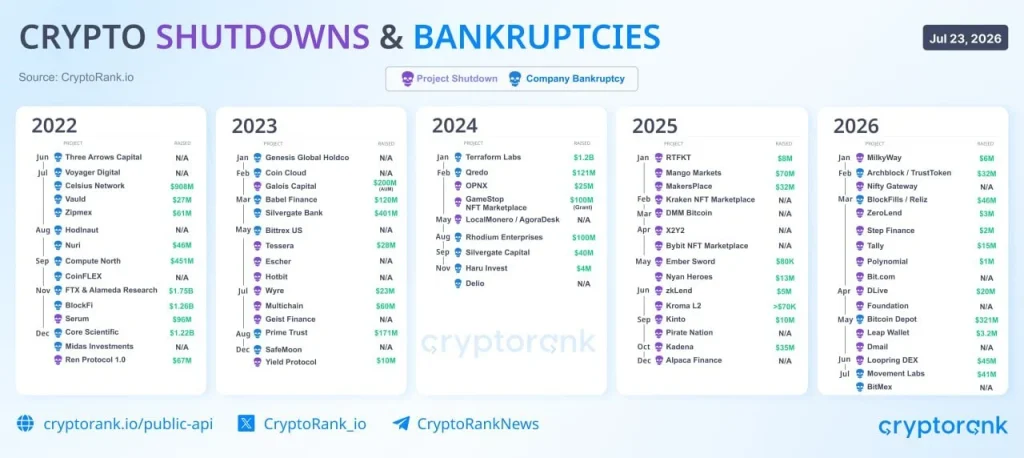
2026’s Crypto Nightmare: 17 Major Shutdowns and $8.9 Billion Lost
As of early 2026, the crypto landscape has witnessed a staggering 17 significant shutdowns and bankruptcies. This isn’t just a number; it represents a seismic shift in the market, one that has left many investors reeling. The combined disclosed funding for these failed projects is an eye-watering $8.9 billion. What does this mean for the future of crypto?
Understanding the Scale of Shutdowns
In 2026 alone, the crypto sector has faced a wave of shutdowns that speaks volumes about the industry’s current state. The 17 companies that have gone under were not small players; they collectively raised billions. This includes various startups and established firms that promised innovative solutions and attracted significant investor interest.
Consider the case of NFT marketplaces, many of which have struggled to maintain user engagement and liquidity. The initial excitement surrounding non-fungible tokens seems to have waned, leading to a consolidation phase where only the strongest platforms survive. This situation is reminiscent of the dot-com bubble burst of the early 2000s, where many tech companies with lofty ambitions failed to deliver, resulting in a significant market correction.
What It Means for Market Consolidation
The current wave of shutdowns indicates a harsh reality check for the crypto market. Companies that cannot deliver genuine value or maintain user interest are being weeded out. This consolidation phase may lead to a healthier market in the long run, as it forces remaining players to innovate and improve their offerings.
For investors, this could signal an opportunity. The remaining companies may have stronger fundamentals and a clearer path to profitability. Historical data shows that post-consolidation phases often lead to robust market recoveries, as witnessed in traditional sectors after periods of extensive shakeouts.
The Financial Impact: A Closer Look
The financial implications of these shutdowns are significant. With $8.9 billion in disclosed funding evaporating, investors are left questioning where the money went and who will be held accountable. This kind of loss can shake investor confidence, particularly in a market already characterized by volatility.
The psychological impact on the market cannot be understated. Fear and uncertainty often lead to decreased investment activity, as traders become wary of potential losses. Data from previous downturns show that such sentiment can linger, affecting market recovery times. Traders should monitor sentiment indicators closely as this situation unfolds.
Lessons from the Past: What Can We Learn?
Each shutdown carries lessons for current and future projects. The market is increasingly favoring transparency, sustainability, and user engagement. Companies that fail to adapt may find themselves facing similar fates. For example, in 2023, a number of crypto projects collapsed due to lack of regulatory compliance, highlighting the need for robust governance structures.
Investors should take note of which companies are pivoting and innovating in response to these challenges. Those that embrace transparency and user-focused strategies are likely to thrive. This is similar to how businesses in traditional sectors have adapted to changing consumer preferences over time.
Regulatory Scrutiny: A New Era
The recent wave of shutdowns will undoubtedly attract increased regulatory scrutiny. Governments worldwide are already grappling with how to regulate the fast-evolving crypto space. This could lead to stricter guidelines regarding funding, operations, and user protection.
For instance, in the wake of significant losses, regulators may impose requirements for companies to disclose their financial health more transparently. This could be a double-edged sword; while it could foster investor confidence, it might also stifle innovation if regulations become too cumbersome.
What Should Investors and Traders Watch For?
As the dust settles on these 17 major shutdowns, investors should remain vigilant. Keep an eye on which projects are adapting and innovating amid the turmoil. Look for companies that prioritize user engagement and regulatory compliance, as these will likely emerge as market leaders.
Additionally, tracking broader market sentiment will be crucial. A shift toward cautious optimism could signal a recovery phase, while continued fear may point to deeper issues in the overall market structure. Monitor trading volumes and investor sentiment closely.
Final Thoughts: The Future of Crypto
This wave of shutdowns is a wake-up call for the entire crypto industry. The lessons learned from the failures of 2026 could shape the future landscape of digital assets. Investors now face a critical juncture: will they choose to invest in innovation and resilience or retreat from a market that has proven to be tumultuous?
With ongoing developments, the implications of these shutdowns will resonate for years to come. For active traders, understanding the dynamics of market consolidation will be essential. Are we witnessing the birth of a more robust crypto ecosystem, or is there more turbulence ahead?
Author: Mark Montgomery