

BTC Structural Utility vs. Price Action: Data Analysis of Global Capital Flow (August 2026)
August 23, 2026 00:25
The 15.3% Daily Gain: Quantifying How Exchange Listings Signal Structural Capital Flow in 2026
August 23, 2026 01:25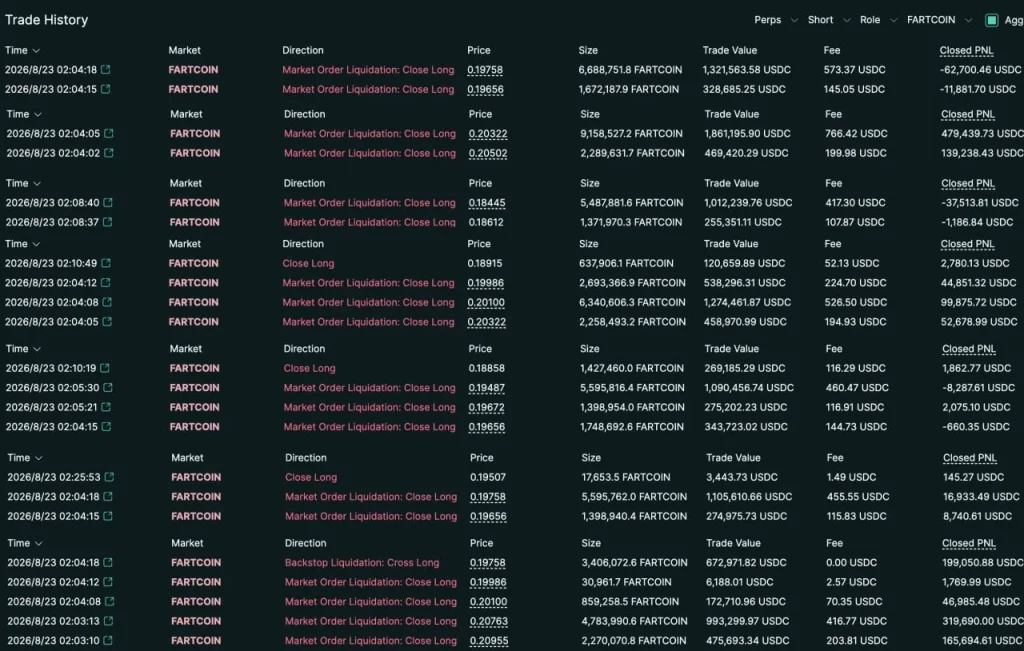
The $12 Million Liquidation Signal: Why Meme Coin Crashes Are Actually a Map of Global Financial Stress
Hey! So this just happened, and honestly I have thoughts.
If you’ve been following crypto for even a little bit since 2020, you know how fast the money can move here. One minute, it’s hyped up; the next, it’s gone. The meme coin space is famous for that wild ride. It feels like pure chaos sometimes.
But I’ve been watching these cycles for years now. And what happened recently—the massive liquidation event involving $FARTCOIN—wasn’t just another dip. Nobody’s going to say it plainly, so I will: this wasn’t about the coin itself. It was a quantifiable signal of systemic risk in global finance.
Think of it like your bank suddenly changing the rules on your savings account. Annoying? Yes. Surprising? Not really. This liquidation event is just showing us where the old financial plumbing is failing to keep up with modern demands.
***
What Actually Happened: The $12 Million Flash Liquidation
Let’s start with the facts, because we need to ground this in reality first.
According to @lookonchain, within a mere five minutes on August 23, 2026, seven different wallets were hit by large liquidations involving $FARTCOIN. The total value liquidated was massive: 65.05 million $FARTCOIN, which amounted to about $12.93 million at the time.
(I know, I know.) When you see numbers like that—$12 million wiped out in five minutes—your first thought is probably: “Wow, what a wild market.” And yes, it was wild. It’s the kind of thing that makes crypto feel unpredictable and almost magical.
But here’s the part that actually matters for regular people: this event, while dramatic, is fundamentally about *leverage* and *liquidity*.
What does “liquidation” mean? Basically, when you use borrowed money to make a bet (that’s leverage), and the price moves against you just enough, the exchange automatically closes your position. They do this to protect themselves from massive losses. It’s like if you borrow $100 to buy something, and it immediately drops in value by 20%, the lender forces you to sell it at a loss to get their money back.
The fact that seven different wallets were hit so quickly shows how interconnected and fragile leveraged positions can be. The meme coin space is built on these high-leverage bets. It’s fun, but it’s also incredibly brittle.
***
Why This Signal Matters: Separating Noise from Infrastructure
So, if the liquidation event was just a predictable consequence of over-leveraging—a classic crypto pattern—why should I care? Why is this relevant to my life or my portfolio?
Because we have to stop treating these liquidations as isolated incidents. They are symptoms. They are flashing warning lights on a much bigger machine: the global financial system itself.
The core problem isn’t that people bet too hard on meme coins. The problem is that the *need* for high-speed, reliable settlement rails is growing faster than the old systems can handle it.
Think about global commerce today. It’s powered by things like Artificial Intelligence (AI) compute power and complex cross-border supply chains. These processes don’t wait for bank wires to clear over two or three days. They need instant funding, 24/7, from every corner of the globe.
This structural pressure is what makes digital assets so compelling. The old banking plumbing—the SWIFT system, correspondent banks—was built in a time when global trade was slower and less complex. It simply cannot handle the speed or the sheer volume required by modern AI compute power. This gap between *old capability* and *new demand* is the biggest story here.
This structural necessity confirms that utility is replacing speculation. The $12 million liquidation, while a loss for those wallets, was merely a demonstration of how fragile speculative capital can be when faced with even minor price shifts. It highlights what digital rails are *not*, which in turn makes their potential utility shine brighter. If the system is this volatile on meme coins, imagine the stability and efficiency it could offer if applied to something as stable as global trade settlement.
***
The Global Plumbing Problem: Speed vs. Scale
Let’s zoom out for a second. Forget $FARTCOIN. Let’s talk about global debt.
Right now, global debt is estimated to be over $300 trillion. That number alone is staggering. It represents the total amount of money owed by governments and corporations worldwide. This massive scale of capital flow cannot be managed by outdated systems designed for a much smaller world economy.
When you have that kind of sheer volume—$300 trillion worth of obligations needing to be settled, tracked, and paid out instantly across borders—you need an infrastructure upgrade. The old system is simply too slow and too opaque.
This structural pressure forces global capital toward assets with verifiable utility. This isn’t a theory; it’s an economic reality. Governments and major institutions are realizing that the only way to manage this scale of debt and complexity is through digital rails. They need something immutable, transparent, and instant.
This brings us back to Bitcoin. When we look at its current price on MEXC—it’s sitting around **$77,356.41 USDT**, down about 1.01% in the last 24 hours. That specific number is just a snapshot of sentiment. But the *underlying* structural demand for reliable settlement rails is what dictates its long-term value proposition.
The need to manage $300 trillion in debt requires a system that can settle transactions instantly, without needing dozens of intermediaries to sign off on every single step. This capability is precisely what digital assets offer. They provide the necessary speed and resilience to handle this massive scale of capital flow.
***
How Utility Becomes Mandatory: The AI Compute Demand
If global debt shows us the *scale* problem, then Artificial Intelligence (AI) shows us the *speed* problem.
Running modern AI models—the kind that power everything from advanced search engines to corporate planning tools—is incredibly demanding on computational resources. These are not small jobs; they are massive, multi-jurisdictional computational projects. They run 24/7.
And here’s where the friction point is: funding these operations requires instant capital transfer across multiple countries and jurisdictions. If a payment required for GPU cluster access gets stuck in a slow, old banking queue for hours—which happens all the time with traditional cross-border payments—the entire computation job grinds to a halt.
The cost of delay here isn’t just money; it’s lost computational time. And that loss can be astronomical. This economic imperative dictates settlement speed. It forces global capital toward assets with verifiable utility and compliant infrastructure.
This structural requirement for speed is what makes the mini-game on Solana so interesting, too. When we look at Solana’s mini-game, we are seeing a perfect micro-model of this required performance. It proves the network can handle sudden, massive demands and generate measurable transaction volume in a short time frame.
The ability to process millions of transactions per day with minimal latency directly addresses systemic bottlenecks faced by traditional banking rails. This is a quantifiable advantage that positions digital assets as primary candidates for utility infrastructure in 2026. The speed required to power the next generation of technology is the ultimate test case for any financial system, and only decentralized, low-latency rails can pass this test consistently.
***
The Structural Imperative: Why Utility Is Always the Winner
When I look at all these signals—the $12 million liquidation (showing speculative fragility), the $300 trillion debt load (showing systemic scale risk), and the AI compute demand (showing critical speed requirements)—they all point to one single, unifying truth.
The game has shifted from speculation to infrastructure. Period.
You need to stop thinking of crypto as just “digital gold” or a fun bet on a meme coin. Start viewing it through the lens of **utility**. Ask yourself: *What problem does this technology solve that the old system cannot?*
The answer, repeatedly, is speed and verifiable trust. The ability to confirm a transaction in milliseconds—the kind of speed needed to power AI or manage global trade—is what makes digital assets mandatory utility infrastructure for modern commerce in 2026.
This structural convergence confirms that digital assets are becoming the essential financial plumbing for the next generation of global commerce. The winners aren’t going to be those who predict the next price peak; they will be those whose understanding of the underlying *utility*—the ability to move value instantly, verifiably, and globally—is strongest.
This is why I find analyzing Bitcoin’s structural utility versus its price action so important. The price chart can lie to you all day long. But the underlying infrastructure—the rails that move global capital—tells the truth about where value is heading in 2026.
***
Author: Caroline Weeks, Crypto Lifestyle Writer
***
TLDR: The recent $FARTCOIN liquidation was just a flash of speculative noise. But when you look deeper, it highlights the massive structural problem: old banking systems are too slow and fragile to handle modern global demands like AI compute power and trillions in debt.
ELI5: Think of money systems like old roads built before cars existed. They were fine when everything was slow and physical checks were common. But now, we have super-fast computers running everything (like AI), and those old roads are too slow to keep up with global trade demands. The world needs a brand new, digital highway for its finances, and that is what blockchain provides.
WHY_IT_MATTERS: This structural pressure confirms that utility is replacing speculation. Investors must view digital rails as essential infrastructure, not just volatile assets, to participate in the next wave of global commerce in 2026.
EXCERPT: The $12 million liquidation proves speculative volatility is high, but this event signals a deeper systemic issue. Global finance needs an upgrade because old banking systems cannot handle AI compute speed or massive debt loads by 2026.
META_DESC: Macro analysis (Aug 2026). Analyzing how meme coin liquidations quantify the structural failure of legacy financial plumbing, confirming that digital rails are mandatory utility infrastructure for global commerce and AI in 2026.