

Crypto VC Market Stays Active While DeFi Funding Falls to New Low
July 20, 2026 17:24
Former New York Governor Andrew Cuomo Joins OKX Board: Implications for the Crypto Landscape
July 20, 2026 17:42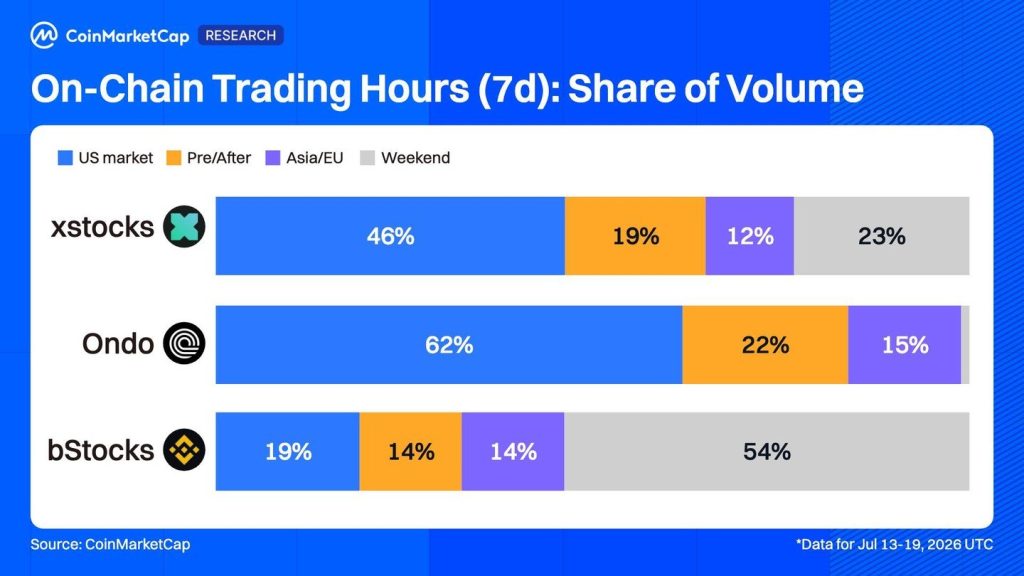
Weekend Trading Dynamics: Analyzing bStocks and Ondo’s Tokenized Stock Markets
Background and Context
The rise of tokenized stocks has revolutionized the way investors engage with traditional equity markets. This innovative approach marries the liquidity of cryptocurrencies with the stability of traditional stocks, allowing for a more flexible trading experience. As of July 13-19, the trading dynamics of two platforms, bStocks and Ondo, reveal significant insights into how tokenized stocks are being utilized across different time zones and market conditions.
Understanding the trading patterns of these platforms is crucial for traders and investors alike, as they highlight the preferences of market participants. With Ondo capturing a staggering 62% of its volume during US market hours and bStocks performing the opposite with 54% of its trading activity on weekends, it’s evident that each platform caters to different trading strategies and investor profiles.
Key Data and Metrics
The data from the week of July 13-19 illustrates distinct trading behaviors on both bStocks and Ondo. bStocks recorded the following distribution of trading volume: 19% during US market hours, 14% during pre- and after-market hours, 14% in Asia-EU markets, and a substantial 54% during the weekend. In contrast, Ondo’s metrics show 62% of its trading volume occurring within US market hours, 22% during pre- and after-market hours, 15% in Asia-EU markets, and a minimal 1% during weekends.
The significant variation in trading volume during weekends on bStocks indicates a possible preference for speculative trading or a strategic approach to capitalize on lower liquidity and price volatility. This behavior could be particularly interesting for day traders looking for opportunities in less crowded market conditions, as discussed in our recent analysis of market activities.
Market Analysis: Implications for Traders
The trading metrics highlight the importance of time in market strategies. For instance, Ondo’s dominance during US market hours suggests that it is attracting investors who prefer to trade during standard business hours when market liquidity is at its peak. The ability to trade tokenized stocks during these hours may provide a sense of security and stability, as traditional stocks are also actively traded.
On the other hand, bStocks’ weekend trading volume might appeal to a more adventurous investor base, potentially including international traders who are capitalizing on price movements when the US markets are closed. This trend could illustrate a growing acceptance of tokenized stocks as a viable alternative investment, particularly for those who are familiar with cryptocurrency trading environments.
Expert Perspectives on Tokenized Stocks
Experts in the field of finance and cryptocurrency have varied opinions on the sustainability of trading practices observed on bStocks and Ondo. Some believe that the shift toward tokenized stocks reflects broader trends in digital asset adoption. As highlighted in our analysis of market stability in Bitcoin movements, the correlation between traditional equities and cryptocurrencies could further enhance trading strategies.
However, there are concerns regarding the regulatory landscape that could impact the future of tokenized stocks. As the SEC continues to scrutinize various aspects of crypto trading and token offerings, platforms like bStocks and Ondo must navigate these complexities to attract and retain investors.
Risks and Opportunities in Weekend Trading
The weekend trading phenomenon on bStocks presents both risks and opportunities. While the potential for high returns exists due to volatility, traders must be aware of the risks associated with lower trading volumes, which can lead to more pronounced price swings. The implications of these dynamics were explored in our recent post on SEC regulatory actions, emphasizing the need for caution in volatile markets.
Opportunity lies in the ability to capitalize on price inefficiencies that can occur during off-peak trading hours. Traders who can effectively analyze market signals during these times may find unique entry points that are less accessible during high-volume trading periods.
Future Outlook for Tokenized Stocks
Looking ahead, the future of tokenized stocks depends significantly on regulatory clarity and technological advancements. As platforms like Ondo and bStocks evolve, they may need to adapt their trading mechanisms to better serve a growing and diverse investor base. Additionally, integrating advanced analytics and AI-driven trading tools could enhance the trading experience and provide traders with actionable insights.
Moreover, as the concept of tokenized stocks gains traction, there could be an increasing number of institutional players entering this space. This potential influx could lead to greater market depth and improved liquidity, benefiting all participants. The implications of these trends for both retail and institutional traders are profound, necessitating continuous monitoring and adaptation.
Conclusion
The trading patterns observed in the recent metrics from bStocks and Ondo underscore the evolving landscape of tokenized stocks. Understanding these dynamics is essential for traders and investors aiming to navigate this innovative market effectively. As the sector matures, ongoing analysis and strategic adaptation will be key for success. For those looking to explore trading opportunities in tokenized stocks, platforms like MEXC offer robust solutions to engage with this emerging asset class.