

Vietnam’s New Regulations on Offshore Crypto Trading: What Investors Need to Know
July 21, 2026 10:38
Tether Gold Gains Recognition in Abu Dhabi: Implications for the Global Crypto Market
July 21, 2026 11:12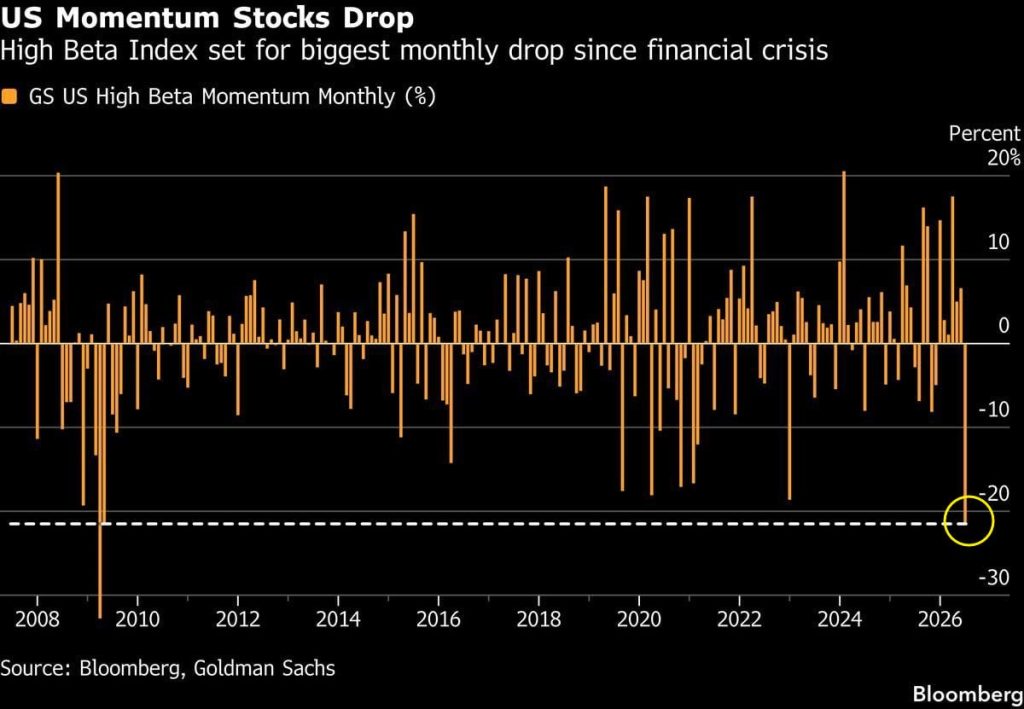
Momentum Stocks Face Largest Monthly Decline Since the Financial Crisis: Implications for Investors
Background and Context
In the ever-evolving landscape of the stock market, momentum stocks—those that have been rising rapidly in price—have recently taken a significant hit. This downturn marks the largest monthly decline for these stocks since the financial crisis of 2008. The decline reflects broader market volatility and investor sentiment shifting towards caution amid rising interest rates and macroeconomic uncertainties. Investors are now re-evaluating their portfolios, especially those heavily weighted in high-growth sectors.
This trend is noteworthy as momentum stocks often lead market rallies due to their rapid growth potential. However, when the market sentiment shifts, these stocks can also fall sharply, leading to significant losses for investors. The recent decline serves as a reminder of the inherent risks involved in chasing high-flying stocks without due diligence.
Key Data and Metrics
Recent data indicates that the S&P 500 momentum index has seen a staggering decline of approximately 12% over the past month. This drop is particularly concerning as it comes after a prolonged period of growth and indicates a potential turning point in market dynamics. Furthermore, the velocity of this decline is reminiscent of the 2008 financial crisis, where momentum stocks also faced severe downturns as the market corrected itself.
Analysts have pointed out that the average price-to-earnings (P/E) ratio for momentum stocks has also decreased significantly, from around 35 to 28 over the past month. This change suggests that investors are now demanding a higher risk premium for holding these stocks, which could further indicate a shift towards value investing strategies rather than growth-focused ones.
Market Analysis
The current market environment is characterized by rising inflation, persistent supply chain issues, and the Federal Reserve’s tightening monetary policy. These factors have collectively contributed to a more volatile atmosphere, leading investors to reassess their risk tolerance. In particular, growth sectors such as technology and consumer discretionary have been hit hard, with many major companies reporting earnings misses that have led to sharp sell-offs.
This shift in investor sentiment can also be seen in the increased volatility of the Nasdaq Composite Index, which is heavily weighted towards technology stocks. The index has experienced swings of over 3% in a single day, reflecting the uncertainty that plagues momentum stocks. Investors looking to capitalize on further market movements should consider diversifying their portfolios and incorporating more stable investments, as discussed in our recent analysis of market strategies.
Expert Perspectives
Market experts suggest that while the recent decline in momentum stocks is concerning, it also presents a unique opportunity for savvy investors. As noted by leading analysts, the current environment may favor value stocks over growth stocks, which could lead to a more balanced market landscape in the coming months. Investors should take this time to reevaluate their positions and consider reallocating funds towards undervalued companies with solid fundamentals.
Moreover, some experts believe that this decline could be a temporary correction rather than a long-term trend. As discussed in our Bitcoin market recovery analysis, fluctuations are common, and markets often rebound after significant corrections. Investors must stay informed and agile, adjusting their strategies accordingly.
Risks and Opportunities
Investors must be acutely aware of the risks associated with investing in momentum stocks during this volatile period. The potential for further declines exists, particularly if economic indicators continue to signal weakness. The possibility of a recession looms large, adding to the uncertainty that could exacerbate the current trends in the stock market.
However, the risk also presents opportunities for those willing to engage in thorough research and analysis. For instance, identifying fundamentally strong companies that have been unjustly impacted by market sentiment could yield considerable returns in the long run. Our analysis of cryptocurrency market dynamics highlights how strategic investment decisions can be made even in downturns.
Future Outlook
Looking ahead, it is crucial for investors to monitor key economic indicators such as inflation rates, unemployment figures, and Federal Reserve policy changes. These factors will significantly influence market sentiment and can determine the fate of momentum stocks in the near term. As businesses continue to adapt to a post-pandemic world, understanding these dynamics will be essential for making informed investment decisions.
Additionally, investors should be prepared for potential volatility as the market adjusts to new economic realities. The strategic move for many may involve diversifying across sectors, as indicated by the recent shifts in market dynamics. Those who can remain patient and disciplined could find themselves well-positioned to capitalize on future gains.
Conclusion
The recent decline of momentum stocks represents a significant event in the landscape of the stock market, reminiscent of past financial crises. As investors grapple with the implications of this downturn, it is essential to remain informed and adaptable. By understanding the underlying factors contributing to this shift and identifying potential opportunities, investors can navigate these turbulent waters effectively. For more insights into current market trends and investment strategies, consider exploring our analysis of trading strategies.